

No products in the cart.
04 Feb 2026
- BY admin
- POSTED IN Skip Hire, Skip Lorry
- WITH 0 COMMENTS
- PERMALINK
- STANDARD POST TYPE
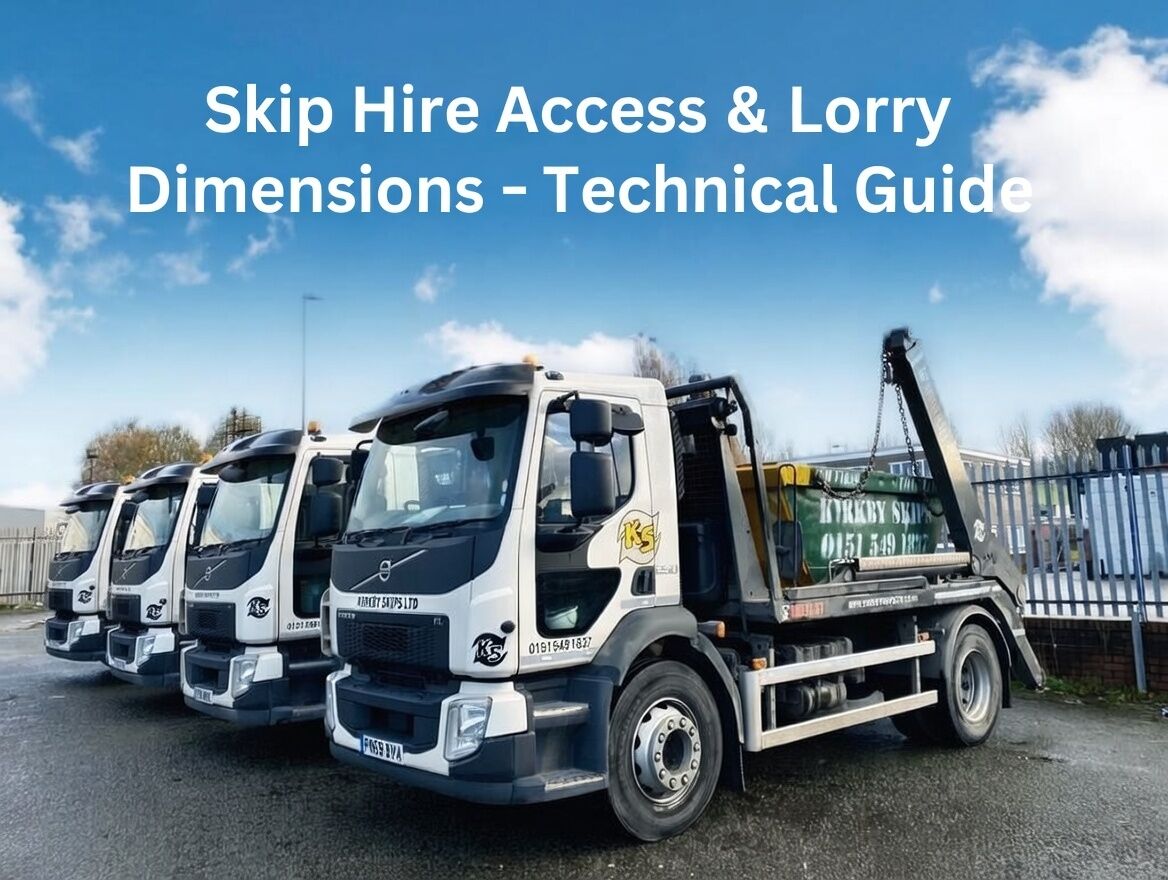
At Kirkby Skips Ltd, we have been providing reliable skip hire services across Liverpool, Knowsley, Sefton, Kirkby, and surrounding areas for years. We know that one of the most common concerns for customers is whether a skip lorry can safely access their property—whether it’s a narrow terraced street in Liverpool city centre, a tight driveway in Kirkby, or a commercial site in Knowsley. Questions like “Will a skip lorry fit down my 9ft drive?” or “Is there enough height clearance for the lifting arms?” come up daily.
This technical guide is designed to answer those questions proactively. We provide exact external dimensions for our skips in both metric (metres and millimetres) and imperial (feet and inches), alongside the precise requirements for our delivery vehicles. By publishing these specifications, we aim to help you plan your skip hire confidently, avoid access issues, and ensure smooth delivery.
All measurements are external and based on our current fleet standards. Note that slight variations can occur depending on manufacturer, but these figures represent what our vehicles and skips typically use.
Why Access and Dimensions Matter in Liverpool
Liverpool’s housing stock includes many Victorian terraces, narrow drives, and urban streets with limited manoeuvring room. Add overhanging trees, low bridges, or overhead cables in areas like Anfield, Everton, or Bootle, and access becomes a real logistical challenge. Choosing the wrong skip size or failing to check access can lead to:
- Delivery delays or cancellations
- Additional charges for failed attempts
- Damage to property (e.g., gateposts or kerbs)
- Safety risks for our drivers and your neighbours
By checking these specs in advance, you can select a skip that fits your site and our lorries can deliver it efficiently. We operate a modern fleet, including recent electric skip loaders, to minimise environmental impact while maintaining reliability.
Our Skip Sizes and Exact Dimensions
We offer a full range of skips from compact midi skips for small home projects to large roll-on roll-off (RORO) containers for commercial waste. Below are the key sizes we supply, with exact external dimensions.
4 Yard Midi Skip (4 Ton) Capacity: 4 cubic yards (approximately 3 cubic metres) / max 4 tonnes External dimensions:
- Length: 2.13 m (7 ft 0 in)
- Width: 1.52 m (5 ft 0 in)
- Height: 0.91 m (3 ft 0 in)
This is our most popular option for domestic clearances, garden waste, or small renovations. Its compact footprint makes it ideal for narrow Liverpool drives or constrained sites.

8 Yard Builders Skip Capacity: 8 cubic yards (approximately 6.1 cubic metres) / max 8 tonnes External dimensions:
- Length: 3.05 m (10 ft 0 in)
- Width: 1.73 m (5 ft 8 in)
- Height: 0.99 m (3 ft 3 in)
The classic builder’s skip suits home extensions, kitchen/bathroom refits, or general construction waste. It offers excellent capacity without requiring excessive space.
12 Yard Skip Capacity: 12 cubic yards (approximately 9.2 cubic metres) / max 10–12 tonnes (depending on waste type) Typical external dimensions (based on standard UK models in our fleet):
- Length: 3.70 m (12 ft 2 in)
- Width: 1.80 m (5 ft 11 in)
- Height: 1.50 m (4 ft 11 in)
Great for larger home renovations or small commercial jobs.
14 Yard Enclosed Skip Capacity: 14 cubic yards (approximately 10.7 cubic metres) / max 10–12 tonnes Typical external dimensions:
- Length: 4.00 m (13 ft 1 in)
- Width: 1.80 m (5 ft 11 in)
- Height: 2.00 m (6 ft 7 in) (enclosed lid adds height)
Ideal for light construction waste, schools, hospitals, or sites where secure containment is needed (e.g., to prevent fly-tipping or weather exposure).
40 Yard Roll-On Roll-Off (RORO) Capacity: 40 cubic yards (approximately 30 cubic metres) / max 40 tonnes Typical external dimensions:
- Length: 7.30 m (24 ft 0 in)
- Width: 2.40 m (7 ft 10 in)
- Height: 2.80 m (9 ft 2 in)
Used for large-scale construction, demolition, or industrial waste. Requires a dedicated RORO vehicle with hook-lift mechanism.
For other sizes (such as 6 yard or 10 yard), please contact us for exact specs as they vary. All skips comply with UK waste regulations and are suitable for mixed waste, hardcore, green waste, or specific streams (subject to permit).
Delivery Vehicle Specifications and Safe Operating Zone
Our standard skip lorries (skiploaders) use hydraulic lifting arms to place skips precisely. We also operate electric models for quieter, lower-emission deliveries.
Standard Skip Lorry Dimensions (for 4–14 yard skips)
- Mirror-to-mirror width: 2.55 m (8 ft 4 in)
- Body width: 2.50 m (8 ft 2 in)
- Height (cab roof): 3.80 m (12 ft 6 in)
- Overall length: approximately 7.50–8.00 m (24 ft 7 in – 26 ft 3 in)
RORO Vehicle Dimensions (for 20–40 yard containers)
- Mirror-to-mirror width: 2.60–2.70 m (8 ft 6 in – 8 ft 10 in)
- Height: 3.80 m (12 ft 6 in)
- Length: 9.00 m+ (29 ft 6 in+)
Safe Operating Zone Requirements To deliver and place a skip safely, our drivers need:
- Minimum access width: 2.74 m (9 ft 0 in) for the entrance or driveway. This accounts for the mirror-to-mirror width (2.55 m) plus a small margin for safe manoeuvring and to avoid scraping walls or fences. Narrower access may require special arrangements or may not be possible.
- Vertical clearance: Minimum 4.50 m (14 ft 9 in) throughout the access route. This allows the hydraulic lifting arms to fully extend and swing without hitting overhead cables, tree branches, arches, or low roofs.
- Additional operating space: At least 1 m clearance on each side of the placement spot for arm swing and stabilisation. The lorry must be able to reverse or turn into position without obstruction.
- Turning and reversing area: Minimum 10–12 m straight run or adequate turning circle (our lorries have a turning radius of approximately 7–9 m).
- Surface: Firm, level ground capable of supporting 18–26 tonnes. Soft lawns or gravel may require boards.
If your site is on a public highway, we can arrange permits with Liverpool City Council.
How to Measure Your Access
- Measure the narrowest point of your drive or access route (gates, pillars, walls). Record in metres or feet.
- Check mirror-to-mirror clearance: If your narrowest point is under 2.74 m (9 ft), contact us first.
- Measure vertical height from ground to lowest overhead obstruction (branches, cables, archways). Ensure at least 4.50 m.
- Walk the route: Note any sharp bends, slopes, or obstacles.
- Check the placement spot: Allow space for the skip plus 1 m around for access.
If in doubt, send us photos or measurements—we’re happy to advise.
Will a skip lorry fit down a 9 ft (2.74 m) wide driveway or entrance for delivery?
Yes, our standard skip lorries are built to handle entrances of 9 ft (2.74 m) or wider, which meets our minimum safe access requirement. This figure includes our vehicle’s mirror-to-mirror width of 2.55 m (8 ft 4 in) plus a necessary safety margin for careful manoeuvring to prevent contact with gateposts, walls, fences, or parked vehicles. We’ve delivered thousands of skips successfully to narrower terraced streets and suburban drives across Liverpool, Kirkby, Bootle, and Sefton using this threshold. That said, sharp bends, steep inclines, or overhanging obstacles can reduce effective space—our drivers may need extra room to reverse or position precisely. If your entrance is exactly 9 ft or has complicating factors, share photos or measurements when booking; we’ll confirm in advance to ensure a smooth drop-off.
Can a skip be delivered and placed on the driveway if the access is only 8 ft wide?
An 8 ft (about 2.44 m) wide driveway or entrance usually falls short of our 2.74 m minimum access requirement (factoring in the 2.55 m mirror-to-mirror width plus manoeuvring clearance), making safe delivery difficult or impossible with our standard lorries. Attempting it risks damage to your property, the vehicle, or requires unsafe operations. In these cases, we often suggest alternatives: our compact 4 yard midi skip (which needs less space and can sometimes be placed using extended hydraulic arms from a nearby wider point, like the road); road placement with a Liverpool City Council skip permit; or multiple smaller skips over time. For very tight urban spots in Anfield, Everton, or Kirkby, we’ve found creative solutions before—send us site photos and we’ll advise honestly on feasibility without wasting your time or ours.
Do I need to worry about overhead height clearance for the skip lorry when hiring a skip?
Yes, vertical clearance is a frequent issue and one of the most important checks—our skip lorries require at least 4.50 m (14 ft 9 in) of unobstructed height along the full access route and at the placement spot. This ensures the hydraulic lifting arms can extend fully and swing safely when loading or unloading the skip, without hitting tree branches, electricity/telephone cables, low arches, overhanging gutters, or garage roofs (very common in Liverpool’s older Victorian/Edwardian properties and leafy suburbs). If clearance is lower—especially seasonally with tree growth or sagging lines—delivery may be halted for safety, leading to a potential wasted-journey charge. Measure from ground to the lowest obstruction using a tape or pole; if it’s close, flag it during booking so our team can assess or adjust (e.g., suggest a smaller skip needing less overhead room).
Can skips be delivered to terraced houses in Liverpool and surrounding areas?
Absolutely—we regularly deliver to classic terraced properties throughout Liverpool (Anfield, Everton, Toxteth, Dingle, etc.), Kirkby, Knowsley, and Sefton. Our modern, compact skip lorries and smaller 4–8 yard skips are well-suited to these tight urban setups, where street parking, narrow frontages, and resident schemes are the norm. Delivery often involves street access (with a council permit if needed) and using the lorry’s reach to place the skip over low walls, through gateways, or on the pavement edge. For best results, opt for a smaller skip and provide clear photos of the street view, entrance, and intended spot when enquiring. Our local experience helps us navigate parked cars, cobbled surfaces, and parking restrictions efficiently—early details from you make all the difference.
What happens if access proves too restricted on the actual skip delivery day?
If our driver arrives and discovers access issues not mentioned beforehand (e.g., unexpectedly parked vehicles blocking the route, lower-than-expected clearance, tighter measurements, or other obstructions), we may not be able to complete safe delivery or placement. We’d discuss immediate options on-site—such as waiting briefly, trying an alternative nearby spot, or rescheduling—but this could incur a failed-attempt charge to cover our driver’s time, fuel, and scheduling impact. To avoid this entirely, we recommend double-checking our published specs against your site in advance and sharing any concerns (plus photos or video) during booking. Clear communication upfront prevents surprises in the vast majority of cases, and it’s why we provide this detailed guide—to help you plan confidently.
Do I need a skip permit from Liverpool City Council, and how does that work?
You only need a skip permit if placing the skip on public land (road, pavement, or verge)—no permit is required for private property like your driveway or garden. In Liverpool, permits are handled by Liverpool City Council and typically cost around £40–£60 (depending on duration and location), with applications taking 3–5 working days. Permits usually last 14 days, include lights/reflectors requirements for safety, and may need parking bay suspensions in controlled zones. We can guide you through the process or arrange it on your behalf in many cases—just let us know your postcode and intended placement when booking. Placing on the road without a permit risks fines, so always check if private access isn’t viable.
More about SKIP PERMITS.
Will the skip lorry or skip itself damage my driveway or surface?
Our skip lorries weigh 18–26 tonnes when loaded, and placing a heavy skip can mark or indent softer surfaces like tarmac, block paving, gravel, or new resin drives—especially with stabilising feet or during wet weather. We take every care (using boards where possible), but damage isn’t always avoidable on delicate surfaces. Firmer concrete or established drives usually cope fine. If your driveway is soft or newly laid, mention it when booking—we may recommend boards (at extra cost), a smaller/lighter skip, or road placement instead. Our drivers have vast local experience and will position to minimise risk.
When ordering a skip for hire, what alternatives are there if my access is too tight for skip delivery?
For properties with very narrow drives (<2.74 m), low clearance, or other restrictions, options include: our 4 yard midi skip (more manoeuvrable); ‘wait and load’ service (lorry waits while you fill, no skip left behind); road placement with permit; or man-and-van style collections for smaller loads. In extreme cases, we can advise on nearby drop-off points with permission. Contact us early with details—we specialise in Liverpool’s challenging urban sites and will find the best workaround.
Is the ground strong enough to support the skip and lorry?
Skips and lorries exert significant weight (up to 26 tonnes), so the placement area must be firm and level—soft lawns, loose gravel, or boggy ground can cause sinking or instability. We may use timber boards to spread the load (extra cost if needed). Avoid manholes, drains, or weak spots. If unsure about your surface, describe it or send photos—we’ll assess and suggest precautions to keep everything safe and damage-free.
How high can a skip be loaded?
For safety and legal compliance, skips must be loaded level with—or below—the top edges of the skip walls (often marked by a visible “fill line” or rim). Waste should never protrude above this level, as overfilled skips become unstable during lifting, transport, or road travel, risking falling debris, fines, or refusal of collection. UK road traffic and construction regulations (including the Road Traffic Act 1988 and related rules) prohibit loads that project beyond the skip’s dimensions. In practice, this means filling to no higher than the skip’s side height—typically around 0.9–2.0 m depending on the size (e.g., up to about 1 m for our 8 yard skip). Heavier materials like rubble should go at the bottom for stability, with lighter items on top. If your waste volume exceeds a level load (common with bulky garden or household clearances), we can advise on a larger skip size upfront to avoid issues. Overloading may result in extra charges, delayed collection, or safety refusals—always aim for a neat, level fill and contact us if unsure.
Can a skip be lifted over a wall or fence during delivery or collection?
Yes, in many cases our skip lorries can lift and place a skip over a low wall, fence, hedge, or similar obstacle using the hydraulic arms’ reach—typically up to about 3 ft (0.9–1 m) in height, depending on the exact setup and skip size. This is a common workaround for terraced houses in Liverpool with narrow frontages, low boundary walls, or limited gate access (e.g., in Anfield, Everton, or Kirkby). However, it depends on factors like wall stability, clear space beyond for placement, no overhead obstructions, and safe arm extension without risking damage or instability. Higher walls (over 3 ft), unstable structures, or sharp angles may prevent this for safety reasons—our drivers assess on-site and prioritise safe operations. If your property has a boundary like this, mention it when booking and send photos of the wall/fence and intended spot; we’ll confirm feasibility early and suggest alternatives (e.g., road placement with permit) if needed. This flexibility is part of our local expertise in handling Liverpool’s varied housing stock.
Is it illegal to put rubbish in someone else’s skip?
Yes, it is illegal to put your rubbish into someone else’s skip without their explicit permission—this is considered fly-tipping under UK waste laws (Environmental Protection Act 1990 and related regulations). Fly-tipping carries serious penalties, including fixed penalty notices starting at £400, fines up to £50,000, or even imprisonment in severe cases. The person who hired the skip (our customer) remains legally responsible for the waste and could face charges or complications if unauthorised items are added, as the waste duty of care falls on them. We’ve seen this happen in built-up Liverpool areas where neighbours spot an open skip—it’s tempting but risky for everyone involved. To deter it, we recommend covering the skip when not in use (tarpaulin or lockable lid options available) or choosing enclosed models for sensitive sites. If you notice unauthorised waste in your skip, photograph it, note details, and report to us or the local council—we can advise on next steps. Always dispose responsibly through your own hire or authorised facilities to stay compliant.